
Going to a Protest
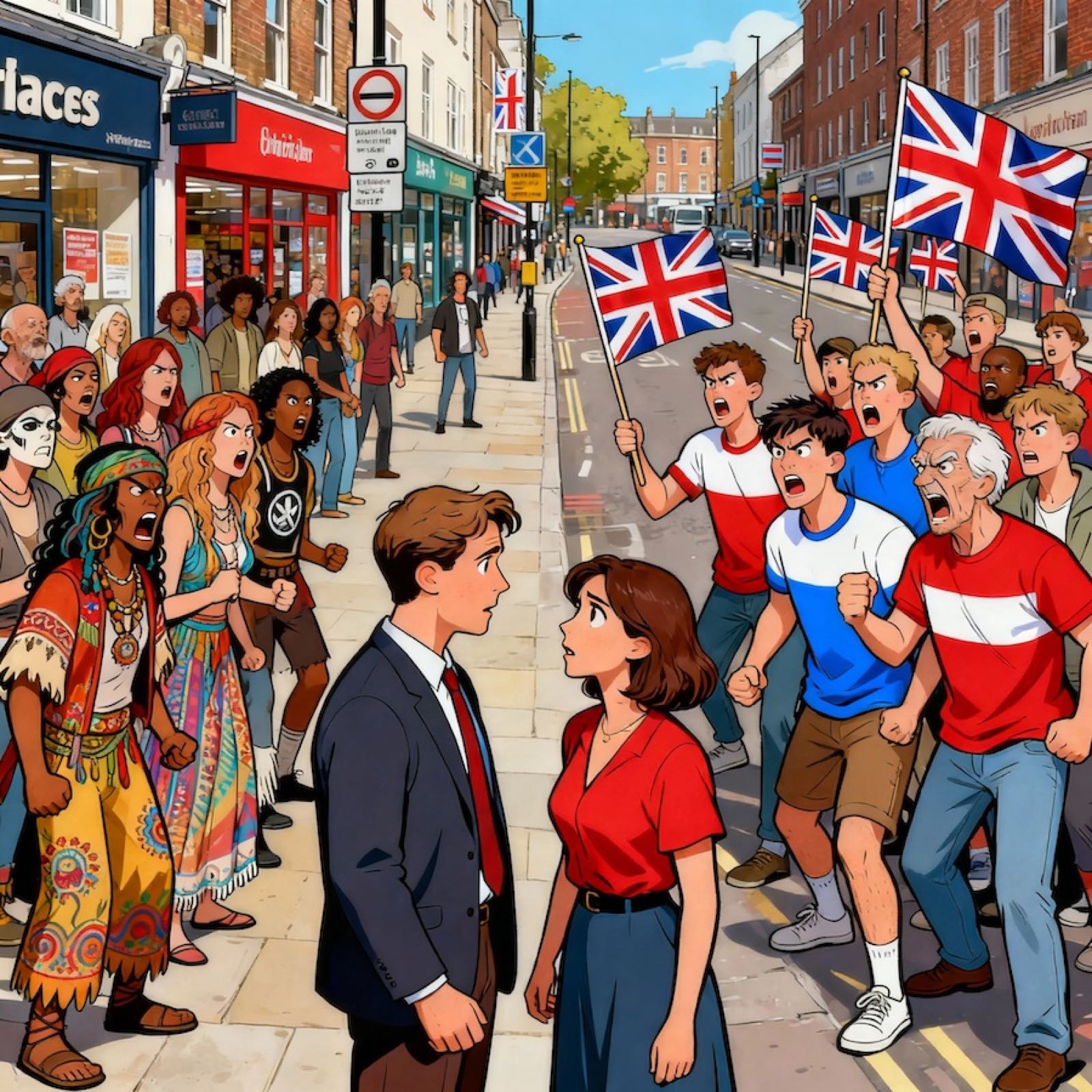
I went to a protest at the weekend.
On one side - mainly men dressed in variations of red, white and blue.
On the other side - a mixed crowd, dressed in mixed colours.
Standing in the middle, I came away with four main observations.
1. The Chants
From one side, things like “Refugees are welcome here” and “This is what community looks like.” From the other, things like “Keir Starmer’s a w*****” and “You can never trust a lefty with your kids.”
2. Anger needs a target
As the person I was with astutely observed - “each side needs the other.” There was a lot of anger around, and the presence of ‘the other’ gave both sides somewhere to point their frustration. By shouting at ‘the enemy’ across the street, they somehow validated each other.
3. The anger was about lots of things
The various flags, posters and placards were expressing anger and/or concern over a lot more than just national pride. There were banners covering everything from refugees to ULEZ. Taken in totality, they were representing the general sense of discontent that a lot of people are feeling. [If you want to give it a fancy name, Peter Turchin calls it popular immiseration].
4. Neither protest was very large.
By my counting, there were 100-150 people on each side. In a town of 30,000, that’s a pretty small proportion of the population. However, the social media coverage [particularly on the red, white and blue side] made it seem a much bigger deal - you could be forgiven for thinking thousands had turned out. But this particular ‘protest’ was actually a bit feeble.
The image on this post is - obviously - generated by AI, prompted by me, and based on the unacknowledged [stolen?] work of thousands of artists. My prompt said “to lean into the stereotypes on each side”.
There’s no doubt that I saw those stereotypes at the weekend. They exist.
But it seems to me that if we are to avoid the extremes, we need to remember that - despite what social media might be telling us - those stereotypes are the minority.
This is not intended to trivialise what’s happening here in the UK. I don’t like it. I’m worried about the increasing polarisation, and where it’s taking us.
And so, I think that those of us who don’t identify with the stereotypes need to speak up.
Because I suspect there’s a lot more than 100-150 of us …